


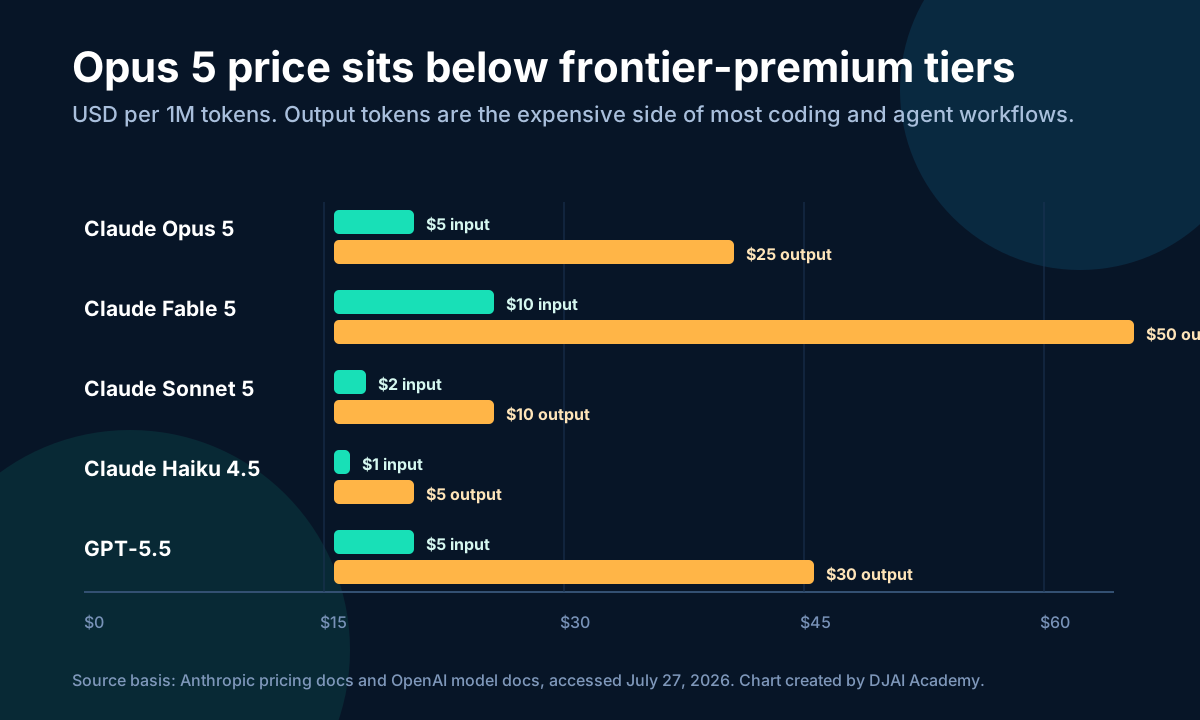
Anthropic's Claude Opus 5 matters because it changes the cost conversation around frontier AI. The headline is not only that a stronger Claude model exists. The more important point for builders is that Anthropic is positioning Opus 5 as a high-capability model with a price profile that is much easier to justify for real production workflows.
What happened
Axios reported on July 24, 2026 that Anthropic released Claude Opus 5, describing it as a model that comes close to the performance of Anthropic's top Fable 5 model while costing about half as much. Axios also reported Opus 5 pricing at $5 per million input tokens and $25 per million output tokens, matching the earlier Opus 4.8 tier.
For people building software with AI agents, coding assistants, document tools, research workflows, or automated business systems, this is a meaningful product signal. The market is no longer only asking which model is strongest. It is asking which model gives enough intelligence at a cost that can survive daily use.
The pricing picture
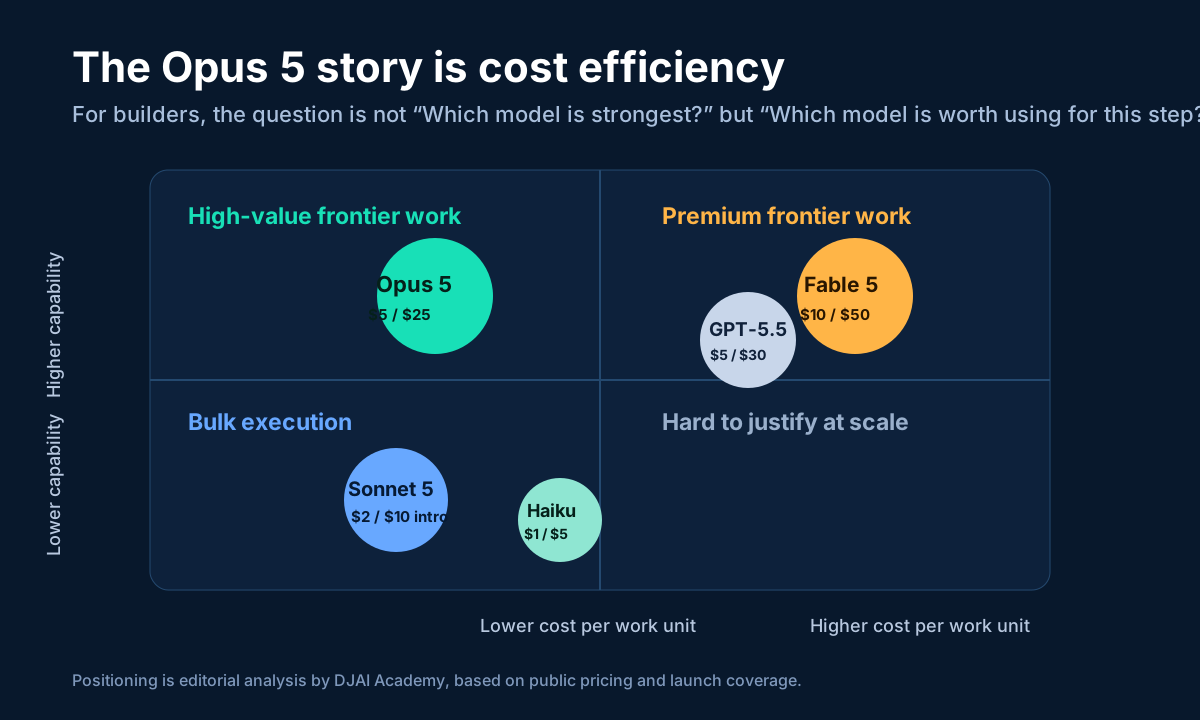
The useful comparison is not simply model versus model. It is task versus task.
A planning task often consumes many input tokens because the model must read requirements, repository context, documents, logs, previous decisions, and constraints. An implementation task often consumes more output tokens because the model must write code, tests, documentation, migrations, or long explanations. Since output tokens are usually more expensive, the model you choose for implementation can have a major cost impact.
This is why a practical workflow may use one model for high-level planning and another model for execution. In my own workflow at Siamese Cat Dev, I often use Claude Code for planning, review, and architectural feedback, then hand the implementation loop to Codex with GPT-5.5 because it can sustain long execution sessions at a favorable rate limit and cost profile. That division is not about brand loyalty. It is about matching model economics to the work.
Why output token cost matters
A common mistake in AI cost planning is focusing too much on input price. Input price matters, but output price can dominate real software work. When an agent writes files, patches bugs, generates documentation, refactors components, and explains decisions, output grows quickly.
That is why Opus 5's reported $25 per million output tokens is important. If the model can provide near-top-tier reasoning for many tasks while staying below the highest-priced frontier options, it becomes more useful for builders who need repeatable workflows instead of occasional demos.
What this means for vibe coding
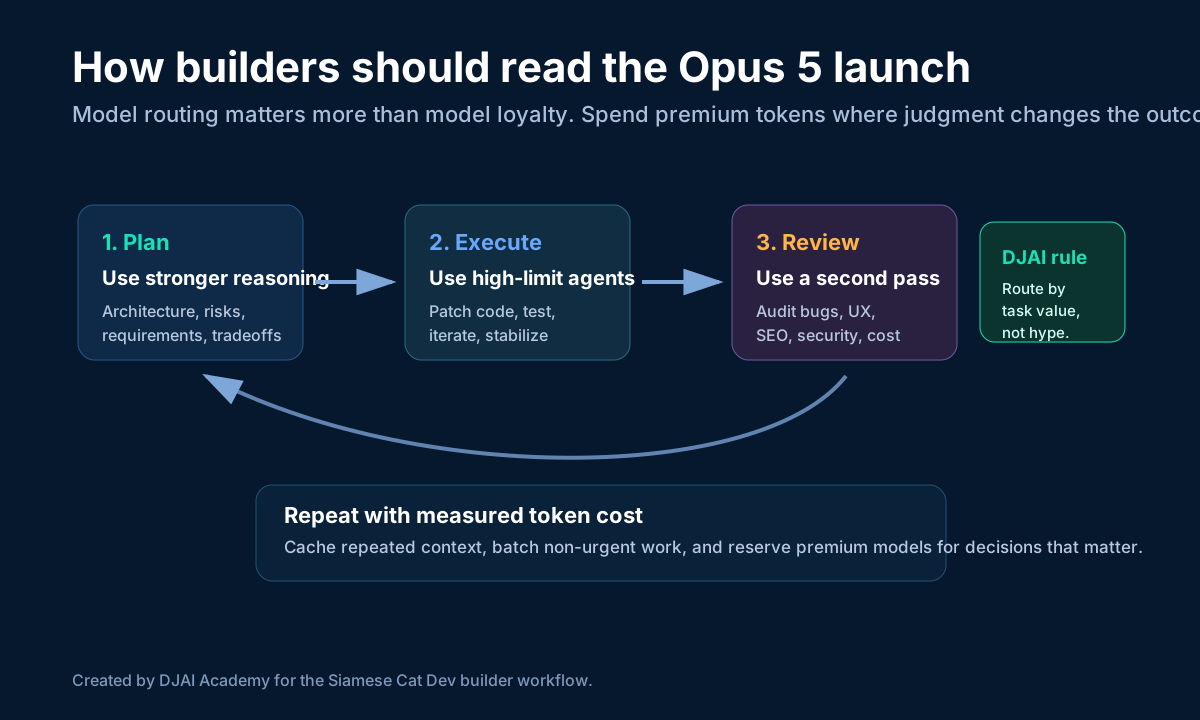
Vibe coding works best when it is not treated as random prompting. A stable workflow looks more like this:
- Use a strong reasoning model to define the goal, architecture, constraints, and likely risks.
- Use a high-throughput coding agent to implement the plan inside the repository.
- Use another review pass to audit the result, find edge cases, and improve quality.
- Run tests, verify the live behavior, then ship.
That workflow lets independent developers get more done without pretending that one model must do everything. Opus 5 strengthens the middle ground: capable enough for serious reasoning, but priced in a way that can make sense for repeated use.
The benchmark story needs caution
Benchmark comparison charts are useful, but they should not be treated as the whole truth. Third-party benchmark summaries suggest Opus 5 is competitive across coding, reasoning, and agentic tasks, while Anthropic's own positioning keeps Fable 5 as the model for the hardest and longest-running work. That distinction matters.
For practical builders, the best benchmark is still your own workload: your repository, your documents, your product requirements, your test suite, and your failure modes. Public charts can help you shortlist models. They should not replace your own evaluation.
Why this matters for small teams
For indie developers, small agencies, educators, and local businesses, AI model choice directly affects what can be built. If a workflow is too expensive, it becomes a demo. If it is affordable and reliable, it becomes part of daily production.
That is why this release is relevant to DJAI Academy and Siamese Cat Dev. Our open-source tools are designed to help people build practical web utilities, learning tools, document tools, and business helpers. Better model economics means more people can experiment, learn, and ship without needing a large engineering budget.
DJAI's practical view
Use the strongest model when the problem is ambiguous, high-risk, or strategically important. Use a cheaper and reliable execution model when the task is clear and the main work is implementation. Then use review and testing to close the quality gap.
This is the pattern behind many of the tools we are open-sourcing under the MIT License. The license lets other developers use, modify, distribute, and even commercialize the code with very low friction, while preserving attribution through the license notice. That openness helps the community because people can learn from real working code, adapt it to local needs, and build businesses on top of it.
Bottom line
Claude Opus 5 is important because it shows where the AI market is moving: not only toward smarter models, but toward models that make economic sense for real builders. The winners will be the developers who learn how to combine planning, execution, review, and cost control into a repeatable workflow.