


I built it as a real product
I just vibe coded a complete mobile application, and I did not build it only as a coding experiment.
I built it as a real product.
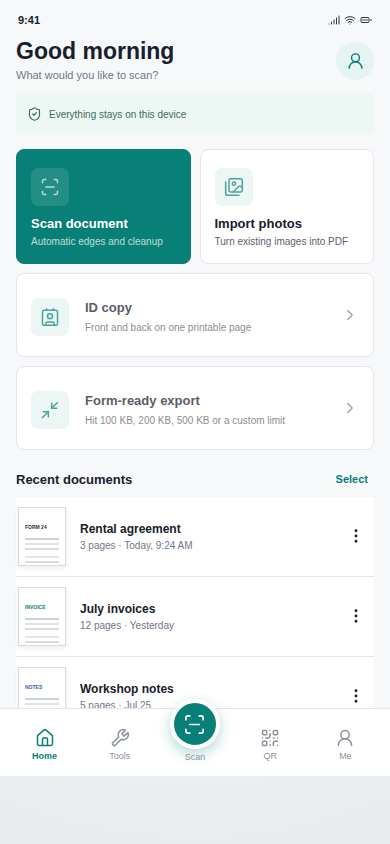
The application is a free productivity tool for scanning documents, signing PDFs, generating QR codes, and helping people finish everyday file tasks without being blocked by subscriptions before they can do the basic job.
This project represents one of the most important lessons I want to share through DJAI Academy:
You do not always need to invent a completely new idea to build a profitable application.
Sometimes, the best opportunity is already sitting directly in front of you. It may be hidden inside an app you already use. It may appear when a platform interrupts you with a payment screen, adds a watermark, limits exports, forces account registration, or locks one simple feature behind a subscription.
These frustrating moments are not only complaints. For builders, they are market signals.
They show where users are unhappy. They show where the product experience is incomplete. Most importantly, they show where a new product may be able to enter the market with a simpler promise.
Why I built a free scanner and productivity tool
Millions of people need to scan documents. Students scan assignments. Employees scan forms. Business owners scan receipts, invoices, contracts, ID documents, and delivery records. Parents scan school papers. Freelancers scan signed agreements. Travelers may need to digitize passports, visas, insurance documents, or booking confirmations.
Document scanning is not a rare use case. It is an everyday utility.
However, many popular scanning applications use aggressive freemium models. Users may face subscriptions, feature restrictions, account requirements, export limits, advertisements, or watermarks placed on their scanned documents.
CamScanner, for example, is one of the most recognized scanning applications. Its official listings describe scanning, PDF creation, OCR, conversion, editing, sharing, and cloud features, and its store pages reference hundreds of millions of users.
That proves one important thing: demand is real.
The opportunity is not guessing whether people need a scanner. Existing products have already validated that market. The better question is: can we provide a simpler, more respectful alternative?
When a user scans an important document, they usually want a clean result. They may need to send it to a school, customer, employer, bank, immigration office, government department, or business partner. A watermark on that document immediately makes the output feel less professional.
The user owns the document. The user used their own phone. The user captured, cropped, corrected, and organized the pages. The final output should not feel like it only becomes theirs after payment.
That frustration became the product opportunity.
The market signal map
| User frustration | What it usually means | Product opportunity |
|---|---|---|
| Subscription appears before the basic task is complete | The app is optimizing monetization before trust | Let the core workflow work first |
| Exported file has a watermark | The free version weakens the user's output | Offer clean export as the main promise |
| Account registration is mandatory | The app adds friction before value | Allow fast use without signup |
| Too many screens and menus | The product is overloaded | Build the smallest useful workflow |
| Private documents must be uploaded | Users may worry about privacy | Prefer local processing where possible |
| Ads interrupt every action | Monetization fights retention | Use ads with restraint and clear placement |
Most people experience a bad product and complain. Builders experience a bad product and investigate. Entrepreneurs experience a bad product and look for the business model hiding behind the complaint.
Whenever users say, “Why do I have to subscribe just to do this?” or “Why does the exported file have a watermark?” you may be hearing the beginning of a product opportunity.
The human part is important here. AI can help build the app, but it cannot automatically decide whether a complaint represents a real market, a small annoyance, or a trap. That judgment still belongs to the builder.
You do not need to beat the market leader at everything
Many new entrepreneurs think their first product must be better than the market leader in every category.
It must have more features. It must support every platform. It must have better AI. It must be perfect before launch.
That mindset stops people from building.
You do not need to beat the leading product at everything. You need to identify a specific group of users and serve one important need better.
Your advantage could be a simpler interface, a faster workflow, clean export without watermark, no mandatory account registration, better privacy, local processing, fewer advertisements, a clearer pricing model, support for a specific language, or a better experience on lower-cost devices.
The opportunity is not always “build more.” Sometimes the opportunity is “remove more.”
Remove unnecessary registration. Remove confusing menus. Remove forced subscription screens. Remove watermarks. Remove complicated onboarding. Remove steps between the user and the result.
For my application, the promise is simple: give users a useful free tool without destroying the core experience.
A practical product workflow
This flow matters because vibe coding can make people skip thinking. The faster the code appears, the easier it is to confuse motion with progress.
The human in the loop must keep asking: who is this for, what job are they trying to finish, where do they feel friction, what can be removed, and what should not be monetized too early?
Free does not mean there is no business model
Some people hear “free application” and assume the product cannot make money. That is incorrect.
Free is a pricing and distribution strategy. It does not mean the business has no monetization model.
Many large digital platforms allow users to access the core product without paying directly. Revenue may come from advertising, premium upgrades, transaction fees, partnerships, enterprise plans, referrals, sponsorships, or additional services.
For this application, my initial monetization model is Google AdMob. Google describes AdMob as a platform that helps app developers earn revenue through in-app advertising, reporting, measurement, and monetization tools.
This creates a different relationship with the user. Instead of blocking an essential function and demanding payment, the app can make the core utility available for free.
Users receive value. The app receives usage. Advertisers receive visibility. The developer can earn revenue when the user base and engagement grow.
But advertising must be implemented responsibly. A free app can become just as unpleasant as a paywalled app if ads interrupt every action.
| Monetization choice | When it fits | Risk to avoid |
|---|---|---|
| Advertising | Broad free utility with many sessions | Too many interruptions |
| Premium upgrade | Advanced features for power users | Weakening the free promise |
| One-time purchase | Specialized tool with clear value | Low repeat revenue |
| Subscription | Ongoing professional workflow | Charging before trust is earned |
| Enterprise plan | Team or business process | Building sales complexity too early |
The goal is not to place the maximum number of ads on every screen. The goal is sustainable balance. An ad should not prevent the user from finishing an urgent task. It should not be disguised as part of the interface. It should not cause accidental clicks. It should not reduce trust.
Short-term impressions are not worth long-term uninstall behavior.
Why advertising can work for utility applications
Advertising is especially interesting for high-volume utility apps.
A user may not scan a document every day, but a broadly useful scanning tool can serve students, employees, parents, freelancers, small business owners, travelers, and general smartphone users across many countries.
The basic logic is:
Useful free tool -> easier adoption -> more users -> more sessions -> more ad impressions -> more revenue.
Profitability is not guaranteed. Revenue varies by country, ad format, advertiser demand, retention, session frequency, fill rate, user consent, platform policies, and product quality. The app also has costs: development, testing, app-store fees, servers, support, analytics, compliance, and maintenance.
Vibe coding changes the economics because it reduces the initial cost and time required to test an idea. One capable builder can now use AI-assisted development to plan the product, generate code, debug errors, create interfaces, write documentation, prepare store content, and accelerate testing.
But the builder still needs judgment. The builder still needs to understand the user, verify the code, test carefully, and make product decisions.
What vibe coding really means to me
Vibe coding is not simply telling AI what to build and accepting whatever code it generates.
For me, vibe coding is the ability to communicate with AI in natural language and use it as a development partner. It helps me move between ideas, product requirements, architecture, user experience, implementation, testing, debugging, and iteration much faster.
The most valuable skill is not typing code quickly. The most valuable skill is thinking clearly.
You need to explain who the user is, what problem they have, what action they want to complete, what the product should do, what the product should not do, which features are essential, which features can wait, how data moves, what happens when something fails, how the interface responds, how the product makes money, and how the user will trust it.
AI can generate a lot of code, but it cannot rescue an unclear product strategy.
That is why I keep a human decision layer in the process. I use AI for speed, but I do not outsource responsibility. I still decide the user promise, the privacy standard, the monetization line, the launch scope, and the quality bar.
The product idea is more important than the code
Many developers begin with technology. They get excited about a framework, model, API, animation library, database, or programming language, then search for a reason to use it.
Entrepreneurs should usually begin from the opposite direction.
Start with the problem.
Ask who experiences it, how often it happens, how painful it is, how people solve it now, what they pay, what they dislike, whether you can offer a better experience, whether you can reach these users, whether the product can retain them, and whether monetization can work without destroying the value.
A technically difficult product is not automatically a good business. A simple application that solves a common problem can be more valuable than an advanced application nobody needs.
Because development is becoming faster, builders should spend more time researching the problem, not less.
How I spot money-making app opportunities
I look for popular products with painful limitations. A large number of users proves the main problem matters. If those users are repeatedly frustrated by one limitation, there may be room for an alternative.
I also look for core tasks that are simple to explain: scan a document and save a clean PDF, generate a QR code, resize a photograph, compress a file, remove a background, merge PDFs, extract text from an image, create an invoice, or track an expense.
Urgency matters too. When someone needs to scan a document, they often need it now. They may be standing in a bank, school, airport, office, shop, or customer location. They do not want to study a complicated product. They want to finish the task.
Existing friction becomes research material. Download competing apps. Use them as a real user. Record every frustrating step. Study onboarding, permissions, paywalls, ads, exports, privacy, file saving, and offline behavior.
Then check whether the initial version is technically feasible. Can the feature work on-device? Does it require expensive cloud processing? Does it involve sensitive data? Can it work on both iOS and Android? What happens on lower-end phones?
The product should be economically feasible, not only technically possible.
Build the smallest useful version
The first version should not be the final vision. It should be the smallest version that delivers the core promise.
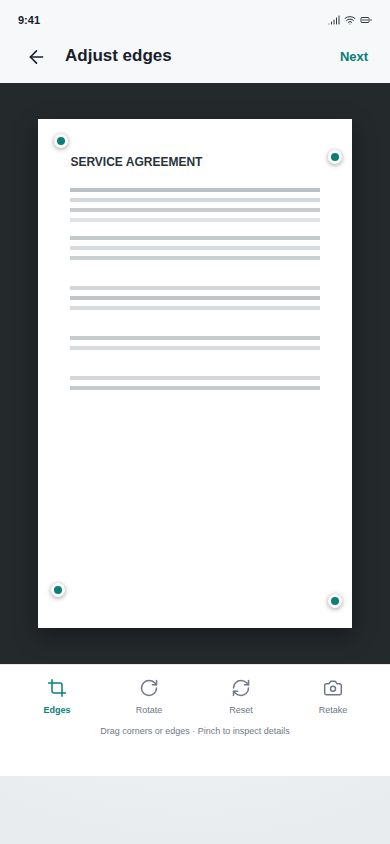
For a scanner app, the essential journey is:
- Open the app
- Capture a page
- Detect or adjust document edges
- Improve readability
- Preview the result
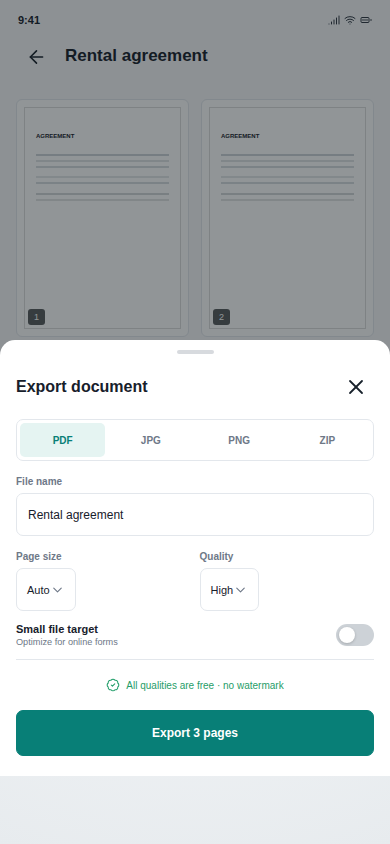
- Export a clean PDF or image
- Save or share it
Everything else can be evaluated afterward.
Do not begin by building twenty tools. Do not build a social network inside a scanner. Do not build team collaboration before you have individual users. Do not create cloud synchronization before determining whether users want local storage.
Build the value first. Then observe.
AI makes it easy to add features. That means saying no becomes even more important.
User experience is part of the business model
A product is not user-friendly simply because it is free.
The user should understand what the app does. Buttons should be clear. The interface should give feedback. Errors should explain what happened. Files should be easy to find. The app should not request access it does not need. The user should understand when an advertisement is being displayed.
This matters commercially because a better experience improves ratings, reviews, retention, recommendations, app-store performance, trust, and long-term revenue.
Free users are not worthless users. In an advertising-supported model, free users are the business. Their attention, activity, retention, recommendations, and feedback create value.
The free version should therefore be genuinely useful.
Distribution is as important as development
Building the app is only one part of the journey. A product cannot generate revenue without users.
For a utility app, app-store optimization matters. The title should clearly communicate the function. The description should use natural search terms. Screenshots should demonstrate the workflow. The icon should be recognizable at a small size.
Video content can also help. I can share why I built the app, how vibe coding accelerated development, how I designed the flow, how I integrated advertising, how I handled privacy, how I tested the scanner, and how users respond after launch.
This is not only marketing. It builds a public record of execution.
Build in public, but protect the user
Scanning applications may handle sensitive documents: ID cards, contracts, invoices, medical documents, financial information, school records, and personal correspondence.
The developer must consider whether files are processed locally, whether anything is uploaded, how long files are stored, what permissions are requested, whether third-party tracking exists, and how the privacy policy explains these practices.
Security and privacy are not decorations. They are part of the product.
A free app should not secretly make users pay with unnecessary exposure of personal documents.
Vibe coding does not remove responsibility
AI-assisted development is powerful, but generated code must be reviewed and tested. AI can produce incorrect logic, insecure storage, broken permission handling, outdated dependencies, poor error handling, unnecessary complexity, performance problems, and privacy risks.
The developer remains responsible for the final product.
Test on real devices. Test permission denial. Test large files. Test unusual camera angles. Test low light. Test storage full. Test interrupted exports. Test advertisements carefully. Verify store policies. Review crashes and user feedback after launch.
Vibe coding increases speed. It should not reduce quality.
A simple framework for DJAI Academy students
| Stage | Builder question | Output |
|---|---|---|
| Problem | What real task are people already trying to complete? | Evidence of demand |
| Gap | Why do current solutions frustrate users? | A focused product promise |
| Build | What is the smallest useful version? | Prototype or MVP |
| Distribute | How will users discover it? | Store, content, SEO, community |
| Monetize | How can revenue support the experience? | Ads, premium, subscription, or services |
This process can be repeated across many industries: PDF converters, image compressors, QR generators, invoice makers, background removers, audio converters, file organizers, expense trackers, scheduling tools, education apps, and small-business tools.
The opportunity may not be creating a completely new category. It may be creating a more focused, accessible, local, private, fast, or friendly version of an existing tool.
My challenge to new builders
For the next seven days, pay attention to every digital frustration you experience.
Write down what you were trying to do, which application you used, what frustrated you, whether other users likely experience the same problem, how frequently it occurs, what a simpler solution would look like, how users currently pay, and how an alternative product could make money.
At the end of the week, choose one idea. Research it. Read reviews of competing products. Define one target user. Write one clear value proposition. Design the smallest useful workflow. Then build a prototype.
Do not wait until you know everything. You will learn by creating, testing, and watching real people use what you made.
Final thoughts
I built this free scanner and productivity application because useful tools should respect users.
A user should be able to complete a basic task without feeling punished for choosing the free version. A scanned document should belong to the user. The core workflow should be clean. Monetization should be sustainable without making the product hostile.
This is what excites me about vibe coding. It allows an individual or small team to move from observation to execution faster than ever before.
But the most important question remains the same:
What valuable problem are you solving?
Do not build only because AI makes it possible. Build because someone needs it. Build because the current experience can be better. Build because you understand the gap. Build because you have a clear way to reach users. Build because you can create value first and monetize that value responsibly.
That is how vibe coding becomes more than a hobby.
That is how it becomes an entrepreneurial skill.
Welcome to DJAI Academy.
Think. Research. Design. Architect. Build. Launch. Monetize.
#VibeCoding #DJAIAcademy #AppDevelopment #AIAppDevelopment #BuildInPublic #MobileAppDevelopment #AdMob #AppMonetization #StartupIdeas #IndieDeveloper #Entrepreneurship #ProductDesign #ArtificialIntelligence #CodingWithAI #FreeTools #DocumentScanner #PDFScanner #CamScannerAlternative #SoftwareBusiness #MakeMoneyWithApps #IndieHacker #DigitalProduct #AppBusiness