


The short version
An agent skill is a reusable operating procedure for an AI agent. It tells the agent when a situation matters, what workflow to follow, what mistakes to avoid, and how to verify that the work is actually done.
That sounds simple, but it changes the way coding agents behave. A normal prompt says, “Please build this feature.” A skill says, “When building a feature, clarify the goal, inspect the repository, plan the change, write or run tests, preserve user work, and only claim completion when verification passes.”
That difference matters because modern coding agents are not weak because they cannot type code. They are weak when they lose process discipline. They jump into implementation too quickly. They patch symptoms instead of root causes. They sound confident before they have evidence. They edit too broadly. They forget the careful engineering behavior you asked for ten messages earlier.
Skills are one answer to that problem.
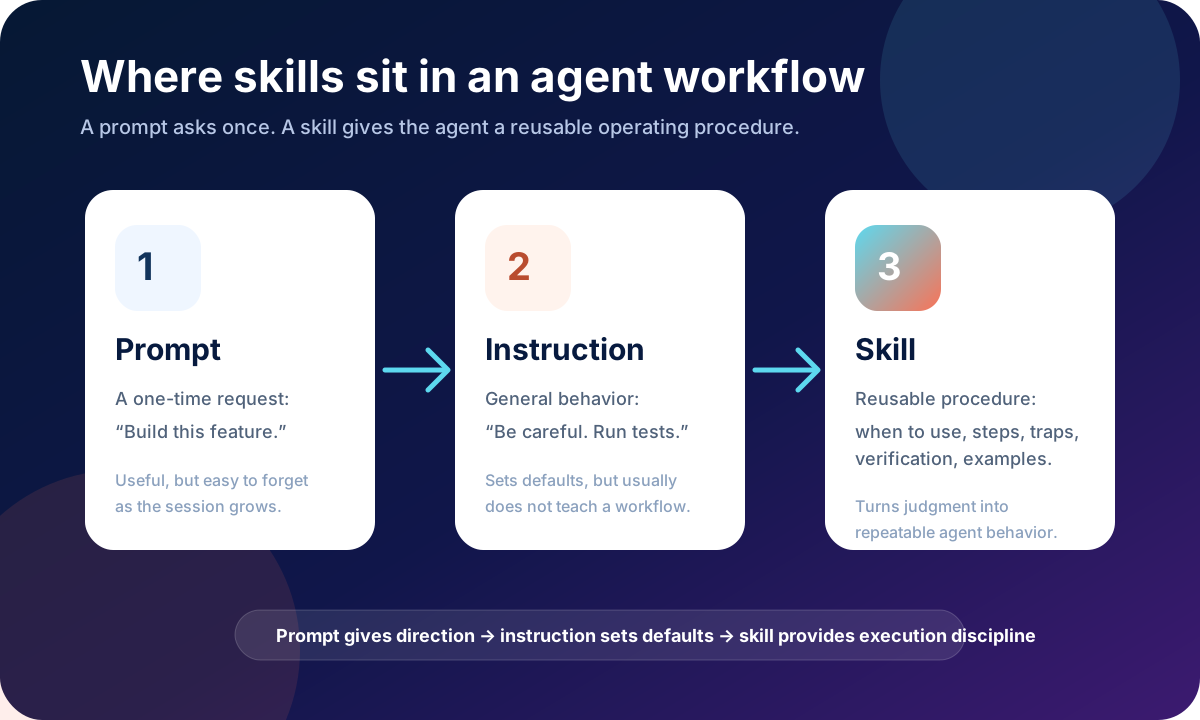
What is a skill for an agent?
In the Superpowers project, a skill is usually a directory containing a SKILL.md file. The file includes metadata, triggering conditions, workflow instructions, examples, and common mistakes. The agent reads the skill when the current task matches the skill description.
The Superpowers repository describes itself as a complete software development methodology for coding agents, built from composable skills and startup instructions that make sure the agent uses them. You can inspect the project at obra/superpowers on GitHub and its skills directory.
A useful skill is not a story about how someone solved a problem once. It is closer to a field manual. It teaches a repeatable technique.
Good skills answer four questions:
- When should the agent use this?
- What should the agent do first, second, and third?
- What shortcuts should the agent avoid?
- What counts as proof that the task is complete?
That last question is important. Agents are good at producing plausible text. Engineering requires evidence.
Skill vs prompt vs system instruction
Most people start with prompts. That is normal. You tell the agent what you want. The agent answers. This is fine for a single question, a small edit, or brainstorming.
But prompts do not scale well when the task becomes long. A prompt is easy to lose in a long session. It is also easy for the agent to satisfy the surface request while ignoring the deeper working method.
System instructions are broader. They define the agent’s general behavior: be concise, protect user changes, run tests, communicate clearly. They are useful, but they are not always specific enough for specialized tasks.
Skills sit between those two layers. They are task-specific. A debugging skill can require root-cause investigation before fixes. A planning skill can require a design before implementation. A testing skill can require red-green-refactor instead of writing implementation first.
Think of the layers this way:
- Prompt: the immediate request.
- System instruction: the agent’s default behavior.
- Skill: the reusable procedure for a known task type.
This is why skills matter for coding agents. They turn engineering practices into reusable behavior.
Why skills matter more for coding than normal chat
Coding has hidden state. A bad answer in a normal chat can be corrected with another message. A bad code edit can break a build, corrupt a migration, remove user changes, or create a production bug.
Coding also has long chains of dependency. The agent may need to read configuration, understand routing, inspect tests, patch code, run a build, update a deployment script, and report the exact result. Without a process, even a strong model can drift.
Skills help because they make the agent pause at the right moments.
For example:
- Before building, use a brainstorming or planning skill.
- Before fixing a bug, use a systematic debugging skill.
- Before claiming done, use a verification skill.
- Before writing a new reusable behavior, use a skill-writing skill.
The key is not bureaucracy. The key is preventing expensive mistakes.
What Superpowers teaches about skills
The Superpowers using-superpowers skill is strict about checking for relevant skills before action. Its main idea is that if a skill applies, the agent must use it before responding, exploring files, or asking clarifying questions. You can read the current file here: using-superpowers/SKILL.md.
That strictness exists because agents rationalize. They think “this is simple,” “I just need one quick check,” or “I can fix this directly.” Those thoughts are exactly where mistakes start.
The skill system works by making useful discipline automatic:
- A bug triggers debugging behavior.
- A feature request triggers design and planning behavior.
- A complex implementation triggers task execution behavior.
- A finished branch triggers verification and handoff behavior.
This is the important shift: the user does not need to remember every engineering rule on every request. The agent learns when to pull the right playbook.
Anatomy of a strong SKILL.md file
A strong skill usually has these parts:
1. Name
The name should be active and clear. systematic-debugging is better than bug-notes. writing-plans is better than planning-stuff.
2. Description
The description should say when to use the skill, not summarize the entire workflow. Superpowers’ writing-skills guide emphasizes this because agents may read only the description and skip the body if the description tries to include the process. See writing-skills/SKILL.md.
3. Overview
The overview should state the core principle in plain language.
Example: “Random fixes waste time. Find root cause before changing code.”
4. Workflow
The workflow should be specific enough to follow but short enough to remember. If the skill is too long, the agent may waste context or miss the point.
5. Common mistakes
This section is critical because agents fail in predictable ways. They skip tests. They assume a route exists. They edit unrelated files. They call work complete because code compiled once. A good skill names those mistakes directly.
6. Verification
A skill should define what proof looks like. “Looks good” is not proof. Tests, builds, screenshots, API responses, logs, and live checks are proof.
Skills as process memory
Developers already use process memory. We have checklists, runbooks, PR templates, incident response guides, architecture decision records, and onboarding documents.
Agent skills are the same idea, but written for the AI worker inside the development loop.
That makes them especially useful for teams. A team can encode its preferred debugging style, deployment checklist, code review standard, migration policy, or testing discipline. Instead of repeating the same instructions manually, the team gives the agent a reusable procedure.
This also makes skills portable. Superpowers is not limited to one coding agent. The project documents installation paths for Claude Code, Codex App, Codex CLI, Cursor, Gemini CLI, OpenCode, Kimi Code, and other environments. The deeper idea is broader than any single model: agent behavior improves when reusable workflows are available at the right time.
Why this matters for founders, creators, and developers
If you use AI to build real software, you need reliability more than speed. Speed without discipline creates cleanup work.
Skills help with the practical failure modes:
- The agent builds the wrong thing because the goal was unclear.
- The agent changes too many files because it did not plan.
- The agent fixes a symptom because it did not investigate root cause.
- The agent reports success without testing.
- The agent forgets your project conventions.
- The agent cannot explain what it changed.
A skill does not make the model perfect. It gives the model rails. It turns “please be careful” into an executable workflow.
A simple skill mental model
Use this model:
- If you say it once, it is a prompt.
- If every agent should always follow it, it belongs in instructions.
- If it applies to a recurring class of work, it should become a skill.
That is the practical value of Superpowers. It shows that the future of AI development is not only better models. It is better working systems around the models.
Final recommendation
If you are serious about using coding agents, start collecting the situations where the agent disappoints you. Did it skip tests? Did it guess? Did it overwrite a file? Did it build too much? Did it stop too early?
Each repeated failure is a candidate for a skill.
Skills matter because they convert painful lessons into reusable agent behavior. That is how coding agents become more like disciplined collaborators and less like autocomplete with confidence.